
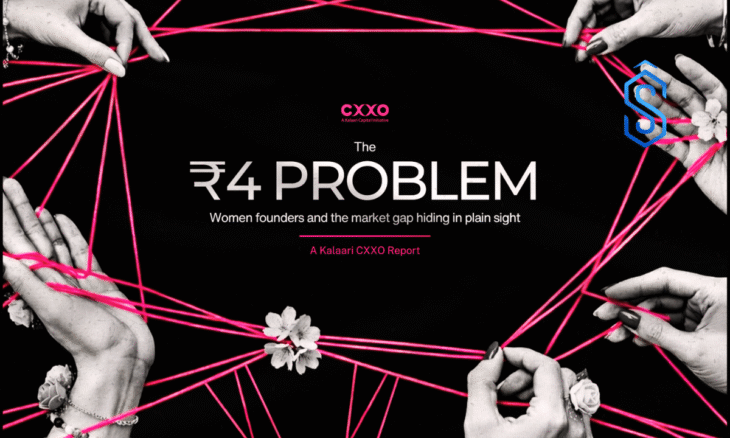
Bengaluru: Kalaari Capital’s CXXO initiative released a new report titled “The ₹4 Problem: Women Founders and the Market Gap Hiding in Plain Sight,” revealing a stark capital imbalance in India’s venture ecosystem.
The Kalaari CXXO report finds that for every ₹100 raised by founders coming from India’s most powerful startup networks, only ₹4 goes to women. Not ₹40. Not ₹14. Four rupees. The findings challenge a long-standing narrative in venture capital that the pipeline of women founders is limited.
Over the past decade, India has seen substantial growth in women’s participation in STEM education. The report notes a 1.7x increase in girls enrolling in high school STEM programs between 2013 and 2024, alongside a twofold increase in women registering for the Joint Entrance Examination (JEE) between 2015 and 2025.
Women also account for a considerable share of STEM graduates in the country. Despite this expanding talent pool, the Kalaari CXXO Report indicates that venture capital funding has not kept pace with the rise in qualified women entrepreneurs.
Also Read: Incubation Fund Management: Poyni Bhatt Calls for Investment-Driven Incubator Strategy
Structural Bottlenecks Identified in the Startup Ecosystem
Drawing on macro ecosystem data from sources including AISHE, NIRF, and Tracxn funding databases, as well as insights from more than 140 founders, operators, and investors, the Kalaari CXXO Report identifies multiple structural barriers that affect women founders across the startup lifecycle.
One of the key observations in the Kalaari CXXO Report is that while women are increasingly present in STEM education, they remain underrepresented in elite institutions that traditionally produce venture-backed startup founders.
The Kalaari CXXO Report also highlights the influence of powerful alumni networks – often referred to as “startup mafias” – that play a critical role in accelerating venture outcomes.
These networks tend to originate from a small group of institutions and companies, and the report notes that women founders are significantly less embedded within these circles.
Another finding in the Kalaari CXXO Report relates to representation within venture capital firms themselves. While women account for approximately 38% of VC analysts, they represent only 16% at the partner level, where key decisions regarding capital allocation are made.
Additionally, the Kalaari CXXO Report points to gender-specific barriers that shape entrepreneurial journeys. These include disproportionate caregiving expectations and other structural factors that often remain invisible in funding data but influence startup outcomes.
Also Read: Building for Bharat’s Stores: How Zithara AI Is Rewriting the Offline Retail Playbook
Venture Capital Narratives Challenged
The Kalaari CXXO Report argues that the funding gap is not simply a matter of diversity but a reflection of deeper structural dynamics within the venture ecosystem.
Vani Kola, Managing Director and Founder of Kalaari Capital, said: “This isn’t a story about capability. It’s a story about opportunity. When capital concentrates around pattern-matched familiarity, the same schools, the same companies, the same networks, blind spots emerge.
Blind spots create inefficiency. And inefficiency, for those willing to see it, creates opportunity. The funding gap isn’t just a question of equality. It’s a failure of price discovery. When an entire category of founders is systematically underestimated, it requires deliberate catalysts to bridge that gap. Until then, the market remains unequal.”
The Kalaari CXXO Report frames the capital gap as a structural market inefficiency with broader economic implications rather than solely a diversity issue.
Kalaari CXXO Report: Economic Implications of the Funding Gap
The Kalaari CXXO Report highlights that advancing women’s economic participation could have significant macroeconomic benefits. Global estimates indicate that increasing women’s participation in the economy could contribute hundreds of billions of dollars to India’s GDP.
Furthermore, the Kalaari CXXO Report points to the financing challenges faced by women-led micro, small, and medium enterprises (MSMEs). Women-led MSMEs in India face a credit gap exceeding $158 billion, reflecting the scale of unrealised economic potential.
CXXO Initiative’s Strategy
Through the CXXO platform, Kalaari Capital aims to address some of the gaps identified in the Kalaari CXXO Report by supporting women founders at the earliest stages of their entrepreneurial journeys.
The initiative positions its investment approach as a conviction-led capital thesis, focused on identifying and backing segments of the startup ecosystem that may have been systematically undervalued by the broader market.
As the Kalaari CXXO Report concludes, the founders exist and the data is clear. The remaining question is whether capital markets are prepared to respond.